Materials
PA 6 and PA 66 nylon moulding: technical polyamide components
We injection-mould PA 6 and PA 66 nylon components to customer drawings, including glass-fibre reinforced grades: tough engineering polymers that replace metal in many applications.
What is PA 6 and PA 66 nylon?
Polyamides PA 6 and PA 66 are the most widely used nylons in technical moulding. PA 66 has a more crystalline structure: it melts at a higher temperature, is stiffer and resists heat and wear better. PA 6 is tougher and absorbs impact better, is processed at lower temperatures and costs less.
Both resist oils, greases and fuels and have good self-lubricating properties. They are hygroscopic: they absorb moisture from the environment, PA 6 more than PA 66, and this affects dimensions and stiffness. Glass-fibre reinforcement, as in PA 66 GF30, increases stiffness and dimensional stability.
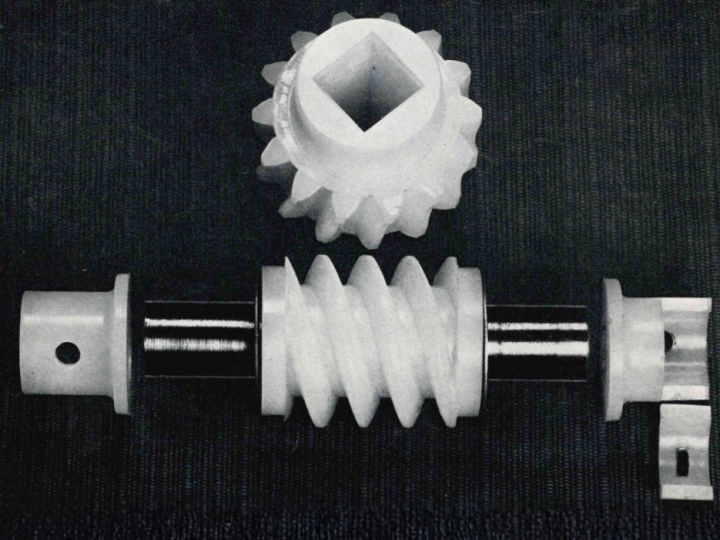
We have been moulding nylon since the 1970s, when we were already producing polyamide gears and bushings for the lifting mechanisms of roller shutters and awnings.
Properties of PA 6 and PA 66 nylon
- High mechanical strength
- Good wear and chemical resistance
- Good electrical insulation
- Rigid (PA 66 is more rigid than PA 6)
Indicative continuous service temperatures for the most common grades: the exact value depends on the grade and formulation and should be checked on the data sheet of the chosen material.
What we have made in nylon
- Gears, pulleys, cams, bearings and guides for the engineering industry
- PA 66 GF30 pump impellers and fittings for hydraulics
- Swivel castors for office chairs, joints, mounts and adjustable feet
- Thread guides, toothed wheels and wear parts for textiles
- Accessories, structural components and fasteners for boats
How we mould PA 6 and PA 66 nylon
Before moulding, the granules must be thoroughly dried: residual moisture causes streaks, bubbles and degradation of the polymer. The mould is kept hot to promote crystallisation and achieve the best mechanical properties.
Nylon or another material?
The material is chosen according to the conditions of use of the component. The closest alternatives:
-
POM Polyoxymethylene
POM absorbs less moisture and is more dimensionally stable; polyamide is tougher and, when reinforced, withstands higher temperatures.
-
PEI Polyetherimide (e.g. ULTEM™)
Beyond the thermal limits of polyamide, or when transparency and flame retardancy are needed, high-performance engineering polymers such as PEI are the next step.
-
PP Polypropylene
For lightly loaded parts in contact with chemicals, polypropylene is lighter and cheaper.
Further reading
Do you have a component to make in nylon?
Send us your drawing or a sample: the contact form opens with the material already selected. If the material is still open, we will choose it together.
Materials
Other materials
- PSPolystyrene
- ABSAcrylonitrile butadiene styrene
- PEPolyethylene
- PPPolypropylene
- PCPolycarbonate
- PVCPhthalate-free polyvinyl chloride
- TPUThermoplastic polyurethane
- SBS / SEBSStyrenic thermoplastic elastomers (TPS)
- POMPolyoxymethylene
- PEIPolyetherimide (e.g. ULTEM™)
- NRNatural rubber
- EPDMEthylene propylene diene rubber
- NBRNitrile rubber (acrylonitrile butadiene)
- VMQSilicone