Materials
Natural rubber (NR) moulding: elastic and anti-vibration components
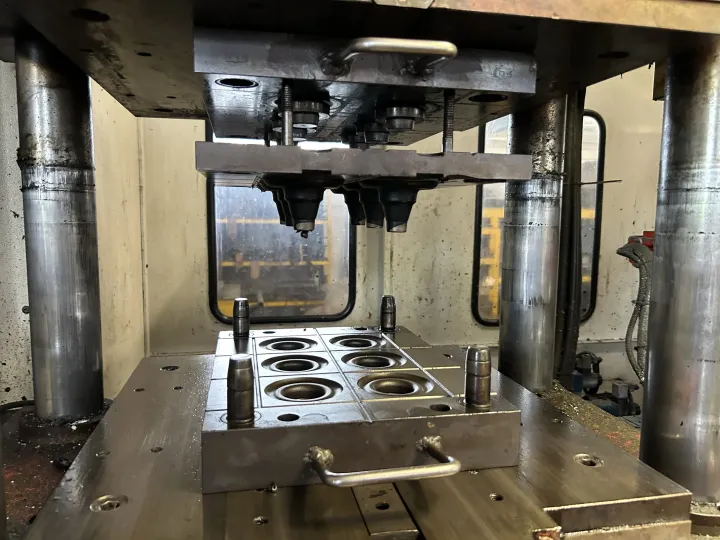
We compression-mould natural rubber components to customer drawings, including parts with metal inserts: a highly elastic, resilient elastomer that absorbs shocks and vibration.
What is natural rubber (NR)?
Natural rubber (NR) is obtained from the latex of the rubber tree (Hevea brasiliensis) and is chemically cis-1,4-polyisoprene. Vulcanisation turns it into an elastomer with very high elasticity, resilience, tensile strength and tear strength.
It is the reference rubber for anti-vibration mounts, shock absorbers and bumpers. It is less resistant than EPDM and NBR to oils, ozone and weathering, so it is chosen when mechanical performance matters most.
Properties of natural rubber
- Elastic
- Tensile-resistant
- Good insulating properties
- Waterproof
A vulcanised elastomer, not a thermoplastic.
Indicative continuous service temperatures for the most common grades: the exact value depends on the grade and formulation and should be checked on the data sheet of the chosen material.
What is natural rubber (NR) used for?
- Silent blocks and anti-vibration mounts
- Shock absorbers and buffers
- Bumpers and end stops
- Cable grommets
How we mould natural rubber (NR)
The natural rubber compound is vulcanised in the compression mould. For silent blocks and mounts it is vulcanised directly onto primer-coated metal inserts: rubber and metal stay permanently bonded.
Natural rubber or another material?
The material is chosen according to the conditions of use of the component. The closest alternatives:
-
EPDM Ethylene propylene diene rubber
For outdoor parts exposed to sun, ozone and water, EPDM lasts much longer.
-
NBR Nitrile rubber (acrylonitrile butadiene)
In contact with oils and fuels natural rubber swells: nitrile rubber (NBR) is needed there.
-
TPU Thermoplastic polyurethane
If abrasion resistance matters and injection moulding is preferred, TPU is a thermoplastic alternative.
Further reading
Do you have a component to make in natural rubber?
Send us your drawing or a sample: the contact form opens with the material already selected. If the material is still open, we will choose it together.
Materials
Other materials
- PSPolystyrene
- ABSAcrylonitrile butadiene styrene
- PEPolyethylene
- PPPolypropylene
- PCPolycarbonate
- PVCPhthalate-free polyvinyl chloride
- TPUThermoplastic polyurethane
- SBS / SEBSStyrenic thermoplastic elastomers (TPS)
- POMPolyoxymethylene
- PA 6 / PA 66Polyamide
- PEIPolyetherimide (e.g. ULTEM™)
- EPDMEthylene propylene diene rubber
- NBRNitrile rubber (acrylonitrile butadiene)
- VMQSilicone