TPU (thermoplastic polyurethane): properties and applications in industrial moulding
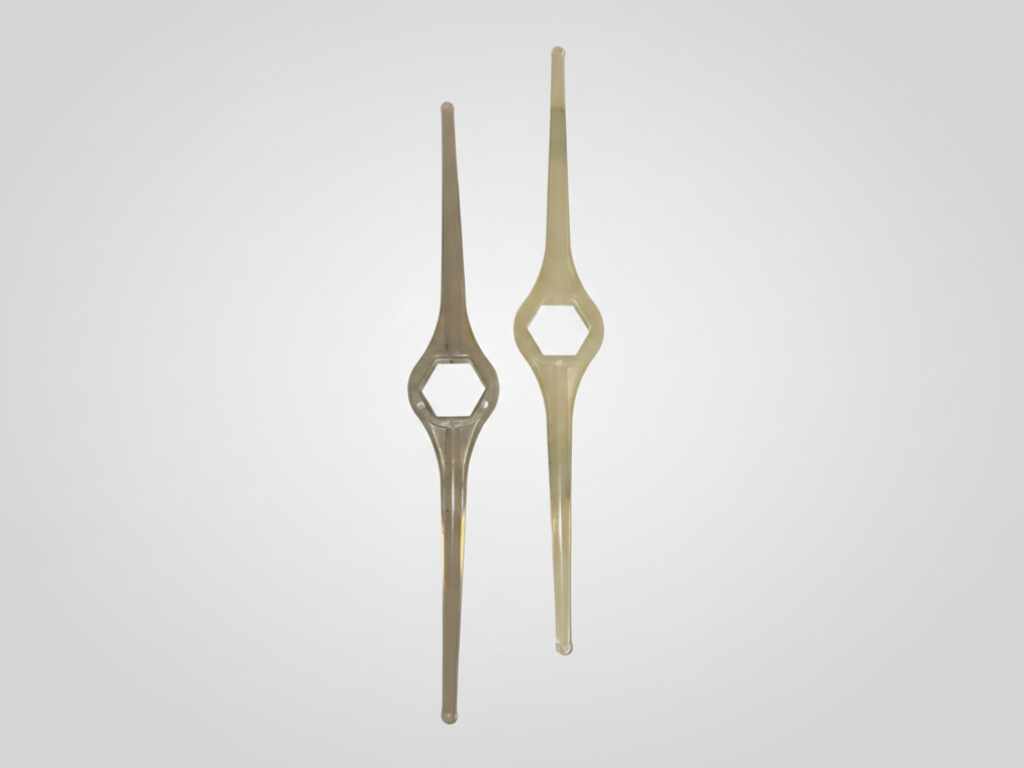
Among the most advanced materials used in injection moulding departments is TPU, a thermoplastic polyurethane with elastomeric behaviour that combines the processability of thermoplastics with the flexibility and elasticity typical of elastomers.
Thanks to these characteristics, TPU (thermoplastic polyurethane) is a versatile, strong and durable solution suited to many industrial sectors, from automotive to industrial design, and offers a sustainable alternative to traditional rubbers.
In this article we look at what TPU is, its main properties, its advantages over other materials and its most common applications in industrial moulding.
What is TPU?
Thermoplastic polyurethane is a high-performance polymer material belonging to the family of thermoplastic elastomers (TPE).
Its high performance comes from a segmented molecular structure made of soft domains and hard domains. This configuration gives the material a unique balance of flexibility, mechanical and abrasion resistance, stability and processability, which sets it apart from other TPEs and makes it suitable even for the most complex industrial processes.
The soft domains are responsible for the elastomeric behaviour of the material, providing high elasticity, shock absorption and shape recovery even after significant deformation.
The hard domains, on the other hand, give TPU the typical properties of thermoplastics, ensuring mechanical strength and dimensional stability. They act as reversible physical bonds that temporarily break apart when heated.
Although it behaves like an elastomer, TPU is not a traditional rubber. Thanks to the reversible bonds of the hard domains it can be melted, shaped and processed with common industrial processes such as injection moulding.
When heated, the material softens and can be processed precisely. On cooling it keeps the shape it has been given without losing its mechanical, chemical or dimensional properties.
This reversibility allows the material to be recovered and reused several times, with significant advantages in terms of recyclability, less scrap and lower production costs compared with traditional elastomers.
Main properties of TPU
The structure of thermoplastic polyurethane, with its alternating soft and hard domains, results in a series of mechanical, chemical and functional properties that explain its wide range of uses.
Elasticity and mechanical strength
It has high elasticity, with an elongation at break of up to 600%, and keeps an excellent elastic recovery even under repeated deformation.
It also shows good fatigue resistance, keeping its mechanical characteristics under cyclic loads and continuous stress.
Tensile strength, between 30 and 50 MPa, is higher than that of many industrial rubbers, ensuring durability, reliability and dimensional stability even under mechanical stress. The material effectively absorbs impacts and vibrations.
Wear and abrasion resistance
In harsh operating conditions, it can be up to ten times more resistant to abrasion than natural rubber. This makes it particularly suitable for components subject to constant friction, ensuring a long service life without deformation.
Chemical stability
It tolerates contact with oils, greases, fuels and many solvents, keeping its mechanical integrity and functionality even in aggressive industrial environments.
Thermal stability
It performs consistently over a temperature range of roughly -40 °C to +120 °C; special formulations can reach peaks of 150 °C.
Even at low temperatures it keeps its flexibility and impact resistance, avoiding the stiffening or brittleness typical of other thermoplastic elastomers.
Adjustable hardness
By varying its chemical composition, it can have hardness grades from Shore A 60 to Shore D 80, suiting both flexible components and components with a more structural role.
Processability and recyclability
As a thermoplastic material, it does not require vulcanisation and can be processed by injection moulding. It can also be remelted and reused, helping to reduce waste and improve the sustainability of production processes.
Resistance to UV and weathering
Some formulations have good resistance to UV rays and weathering, keeping their mechanical stability and appearance over time. This allows the material to be used in outdoor applications too, reducing degradation, discolouration and loss of performance.
Finish and design
Its natural transparency allows neutral or coloured parts, combining high technical performance with aesthetic and functional requirements.
Applications of TPU in different industrial sectors
The ability to adjust the composition and additives in the TPU formulation makes it possible to obtain materials with specific characteristics, adaptable to different application requirements. This design flexibility explains its wide use in modern industrial moulding in many sectors.
Below are some of the main applications we can design and develop to measure.
Furniture
In the furniture sector, TPU is valued for its combination of flexibility, impact resistance and aesthetic quality, which makes it possible to produce durable and functional components such as:
- slat holders for orthopaedic slatted bed bases
- shock-absorbing feet for furniture
- inserts for seating
- decorative profiles
- seals for joints
- coverings for design components with neutral or coloured finishes
Textiles
In the textile sector, TPU is ideal for elastic and strong solutions suited to intensive cycles and repeated stress. Applications include:
- flexible eyelets
- cord ends
- belt loops
- soft supports
- anti-slip inserts for technical clothing
- solutions for industrial textiles
Lighting
Thanks to its insulating properties and thermal stability, the material is used for components exposed to heat and electrical stress, such as:
- electrical insulators
- lamp suspension hooks
- spotlight supports
- covers resistant to heat and electrical discharges
Manufacturing
In the manufacturing industry it is a reliable solution for components subject to wear, vibration and mechanical stress. It is used to produce:
- industrial seals
- closure caps
- sealing rings
- anti-vibration dampers
- elements for assembly lines
- components for olive harvesting systems
- protective coverings for machinery
Hydraulics
Its resistance to water, oils and chemicals makes TPU particularly suitable for components for hydraulic systems, such as:
- flexible hoses
- sealing gaskets
- spools for fluid handling
- valves and connection devices
Boating and marine
In the marine sector it is used for elastic and protective components exposed to water, UV rays and impacts. The main applications include:
- fenders for boats
- shock-absorbing end caps
- coverings for metal supports
- overmouldings for marine equipment
- protection for external components
Automotive
In the automotive sector it is used for technical components that require strength, flexibility and long-term stability, such as:
- dashboard grommets
- anti-vibration mounts
- fuel hoses
- technical coverings for electrical systems
- protection for electric vehicle batteries
Railway
In the railway sector it is chosen for components subject to constant mechanical stress and high safety requirements, such as:
- shock absorbers for carriages
- wheels for sliding systems
- elastic supports for infrastructure


Conclusion
TPU combines elasticity, strength and processability, making it a versatile solution for technical and design applications.
Thanks to our experience in moulding elastomers, plastics and engineering polymers, Corti Srl is the ideal partner to design and produce custom TPU components, ensuring quality, precision and reliability.
We also offer two-component overmoulding solutions, combining TPU with rigid plastic or metal inserts to produce complex components.
For further information, please contact us. We will be happy to provide technical support and help you choose the solution best suited to your needs.
Sectors: FurnitureManufacturing and industrial machinery
Materials: TPU