Rubber-to-metal overmoulding: process, advantages and applications
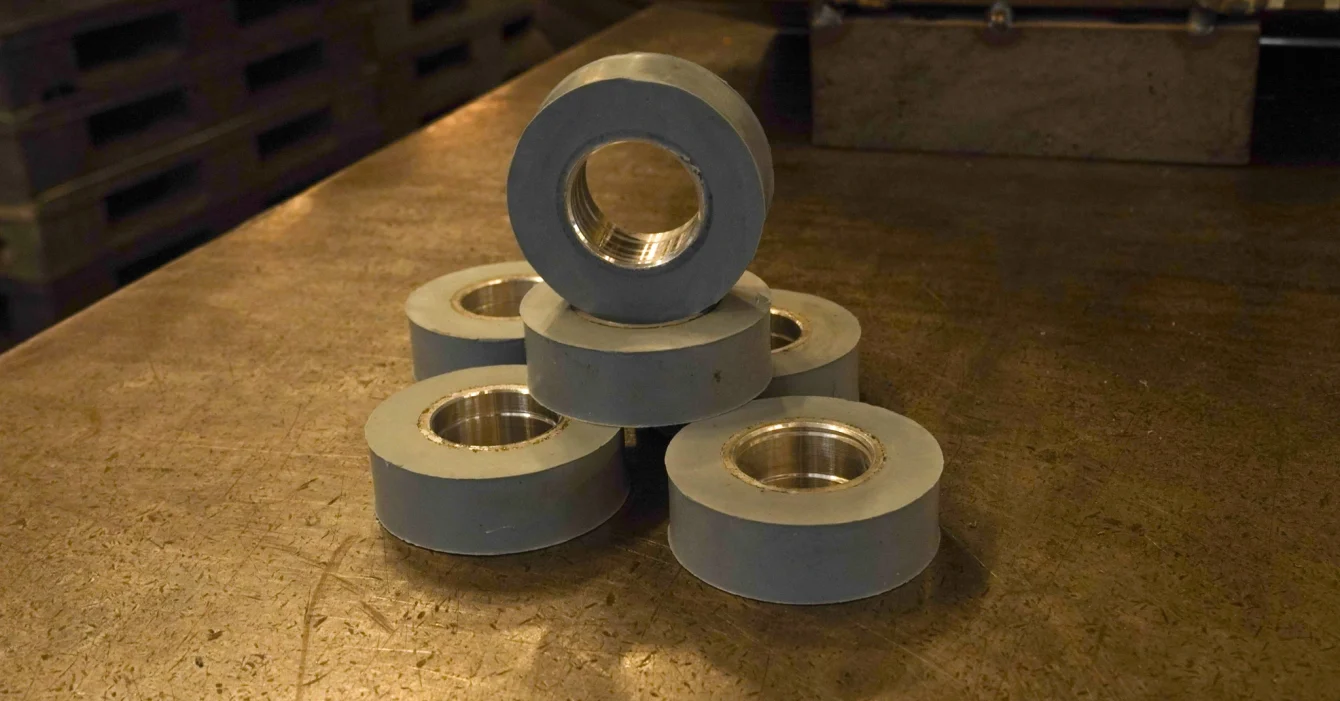
Rubber-to-metal overmoulding, also known as co-moulding, insert overmoulding or insert moulding, is an advanced and highly engineered manufacturing technology for producing composite components in which rubber and metal are permanently integrated.
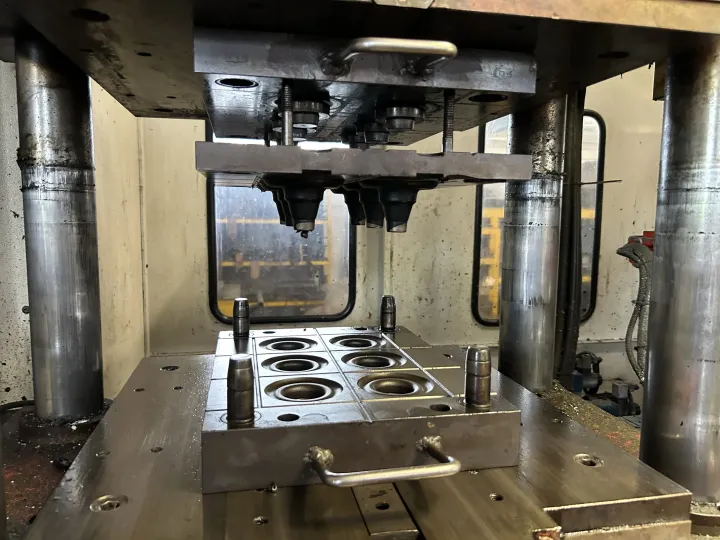
The process involves placing a preformed metal insert – suitably machined and shaped – inside the mould, and then overmoulding a layer of rubber onto it.
This process is particularly valued because it combines the complementary characteristics of the two materials, ensuring high performance, reliability, durability and versatility.
In the following sections we look in detail at how the process works, its main advantages over other traditional solutions and its industrial applications.
How does rubber-to-metal overmoulding work?
The first step of rubber-to-metal overmoulding is preparing the metal insert, which is essential for optimal adhesion of the elastomer. The metal surface is carefully cleaned and sandblasted to remove impurities and create a surface roughness that promotes mechanical adhesion. A specific adhesive, called a primer, is then applied, chosen according to the type of metal and elastomer used.
At the same time, the rubber is precisely weighed and cut into strips. The metal insert is then placed in the mould and the polymer is distributed around or over it and compressed. The heat and pressure of the heated mould trigger the vulcanisation process, allowing complete crosslinking of the elastomer’s polymer chains and the formation of a stable chemical bond between rubber and metal. The production cycle typically lasts from 10 to 90 minutes, at temperatures between 140 and 170 °C, depending on the compound used and the size of the part.
At the end of the cycle, the overmoulded part is removed from the mould and deflashed to remove any excess material.
The finished overmoulded component has a chemical rubber-to-metal bond thanks to the primer and the crosslinking of the polymer. In addition, any irregularities or undercuts deliberately created on the surface of the insert help the rubber to interlock, creating a mechanical bond. The result is a permanently integrated composite part that ensures robustness, strength and durability.
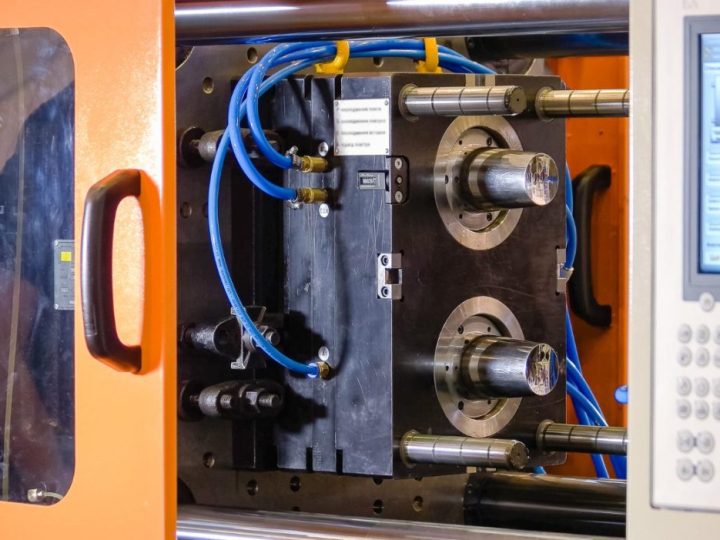
Compression overmoulding is used for all thermoset elastomers, such as EPDM, NBR and silicones. For thermoplastic elastomers such as TPE, TPU and SEBS, injection overmoulding is used: the molten material is injected into the mould around the metal insert and, as it cools, solidifies around the metal surface. This ensures a stable mechanical bond between elastomer and metal, using undercuts and surface geometries designed to maximise the interlocking of the polymer.
Advantages of rubber-to-metal overmoulding
Rubber-to-metal overmoulding offers many technical and economic advantages, which make the process highly competitive compared with traditional assembly techniques. The main benefits of this solution are described below.
Structural rubber-to-metal adhesion
Overmoulding ensures a solid and permanent structural bond between rubber and metal, provided by the chemical bond and/or mechanical bond developed during the process. It therefore performs better than manual bonding, significantly reducing the risk of detachment even under mechanical stress, pressure and vibration.
Optimised production process
The process delivers a component that is already assembled at the end of the cycle, eliminating manual bonding and assembly steps. This integration reduces operating costs and production times and increases efficiency on automated lines.
Functional integration of materials
The rubber-to-metal solution combines materials with different mechanical characteristics in a single component. The metal provides stiffness and structural strength, ensuring dimensional accuracy and stability under mechanical loads. The rubber provides elasticity, flexibility, shock and vibration isolation and sealing. The result is a high-performance engineered component.
Advanced design flexibility
The process supports complex geometries, the integration of technical inserts and the use of different materials to optimise functional performance. In general, its versatility makes it possible to develop customised solutions for very different sectors and operating conditions.
Component reliability and durability
Eliminating mechanical joints and external bonding increases the overall robustness of the component, which keeps its integrity even under harsh thermal, chemical and operating conditions, extending its service life and reducing the need for maintenance.
Production efficiency and lighter components
The functional combination of rubber and metal makes it possible to design lighter components, using metal only where structural stiffness is needed. This reduces the weight of the component without compromising its performance and improves production efficiency through optimised use of materials.
Applications of rubber-to-metal overmoulding in different industrial sectors
Rubber-to-metal overmoulding is used in many industrial sectors. At Corti Srl we use the process to produce articles for the automotive, railway, hydraulics, manufacturing, furniture, lighting, marine and textile industries. Some application examples follow.
Automotive and railway
In the automotive and railway sectors, the process is used to produce anti-vibration mounts, silent blocks, bushings, flexible couplings and seals, essential components for reducing vibration and noise and ensuring stability and safety.
Hydraulics and manufacturing
In the hydraulics and manufacturing sectors, overmoulding is used for valves, pumps, diaphragms and sealing systems, where the rubber-to-metal bond ensures tightness, mechanical strength and long service life. It is also used for damping elements, functional supports, blocks and wheels for conveyor belts, which above all require mechanical strength and durability, as well as vibration damping.
Furniture
In the furniture sector, the technology is used to produce feet, caps, spacers and technical supports with overmoulded metal inserts that ensure stability, load-bearing capacity and wear resistance.
Lighting and marine
In the lighting and marine sectors, this solution is used for insulation and protection elements that are often exposed to severe environmental conditions such as humidity, vibration or temperature changes.


Conclusion
Rubber-to-metal overmoulding is a key manufacturing solution for components that combine elasticity, strength and stability, ensuring high performance even in the most demanding operating conditions. Thanks to its versatility it can be applied in many industrial sectors, providing composite elements that meet requirements for reliability, durability and mechanical precision.
Corti Srl offers a technical team highly specialised in overmoulding, able to support companies from the selection of the most suitable materials to the design and preparation of the metal inserts, up to the development of tailor-made solutions for specific production needs.
For further information or to develop a custom project, contact us to request dedicated technical advice.